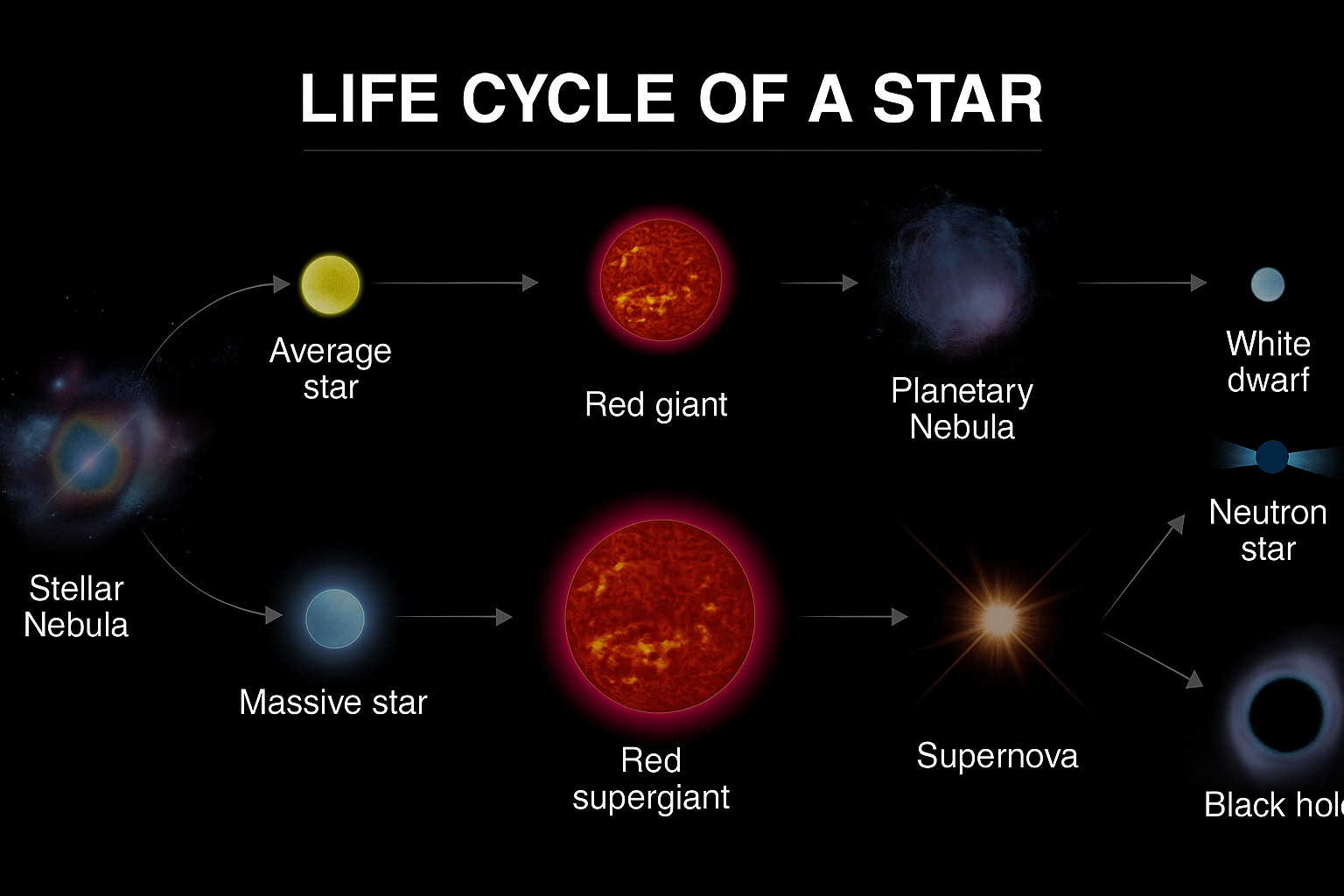
Stars are the brilliant engines of the universe. From the faint glimmer of a distant dwarf to the explosive finale of a supernova, each star follows a fascinating journey through space and time. Let’s explore how stars are born, live, and eventually die—a stellar life cycle that spans millions to billions of years.
—
🌌 1. Birth: The Stellar Nursery
All stars begin their lives in nebulae, massive clouds of gas and dust scattered throughout galaxies. Gravity pulls the gas and dust together into dense clumps. As these clumps grow, their cores heat up, forming a protostar.
If the protostar gains enough mass, its core temperature reaches around 10 million degrees Celsius, and nuclear fusion begins—marking the birth of a true star. The fusion of hydrogen into helium releases immense energy, causing the star to shine.
—
☀️ 2. Main Sequence: The Star’s Prime
Once nuclear fusion starts, the star enters the main sequence phase—the longest period of its life. Our Sun is currently a main sequence star.
During this stage, the star maintains a balance between the inward pull of gravity and the outward pressure from fusion. Depending on its mass, a star can stay in this phase for millions (if massive) to billions (if smaller like our Sun) of years.
—
🔥 3. Red Giant or Supergiant: Aging Gracefully
When a star exhausts its hydrogen fuel, fusion slows, and gravity causes the core to collapse. As a result, the outer layers expand and cool, turning the star into a red giant (for low to medium mass stars) or a red supergiant (for high mass stars).
In this phase, stars start fusing helium into heavier elements like carbon and oxygen. The more massive the star, the more elements it can produce—up to iron in the largest stars.
—
💥 4. The Death of a Star
The star’s final fate depends on its mass:
🌬️ Low to Medium Mass Stars (like our Sun)
These stars gently shed their outer layers, forming stunning planetary nebulae. The remaining core becomes a white dwarf—a dense, Earth-sized object that slowly cools over billions of years.
💣 Massive Stars
In a dramatic finale, massive stars explode in a supernova—one of the most energetic events in the universe. This explosion spreads heavy elements into space, seeding future generations of stars and planets.
After the explosion, the core can become either a:
Neutron Star: A super-dense object made mostly of neutrons.
Black Hole: If the core is massive enough, gravity crushes it into a point of infinite density—creating a black hole.
—
🌠 A Cycle That Continues
The elements created in stars—including carbon, oxygen, and iron—are the building blocks of planets, life, and even humans. When stars die, they enrich space with these elements, fueling new generations of stars and galaxies.
So next time you look up at the night sky, remember: you’re not just seeing light—you’re witnessing the cosmic story of birth, life, and death written in the stars.
—