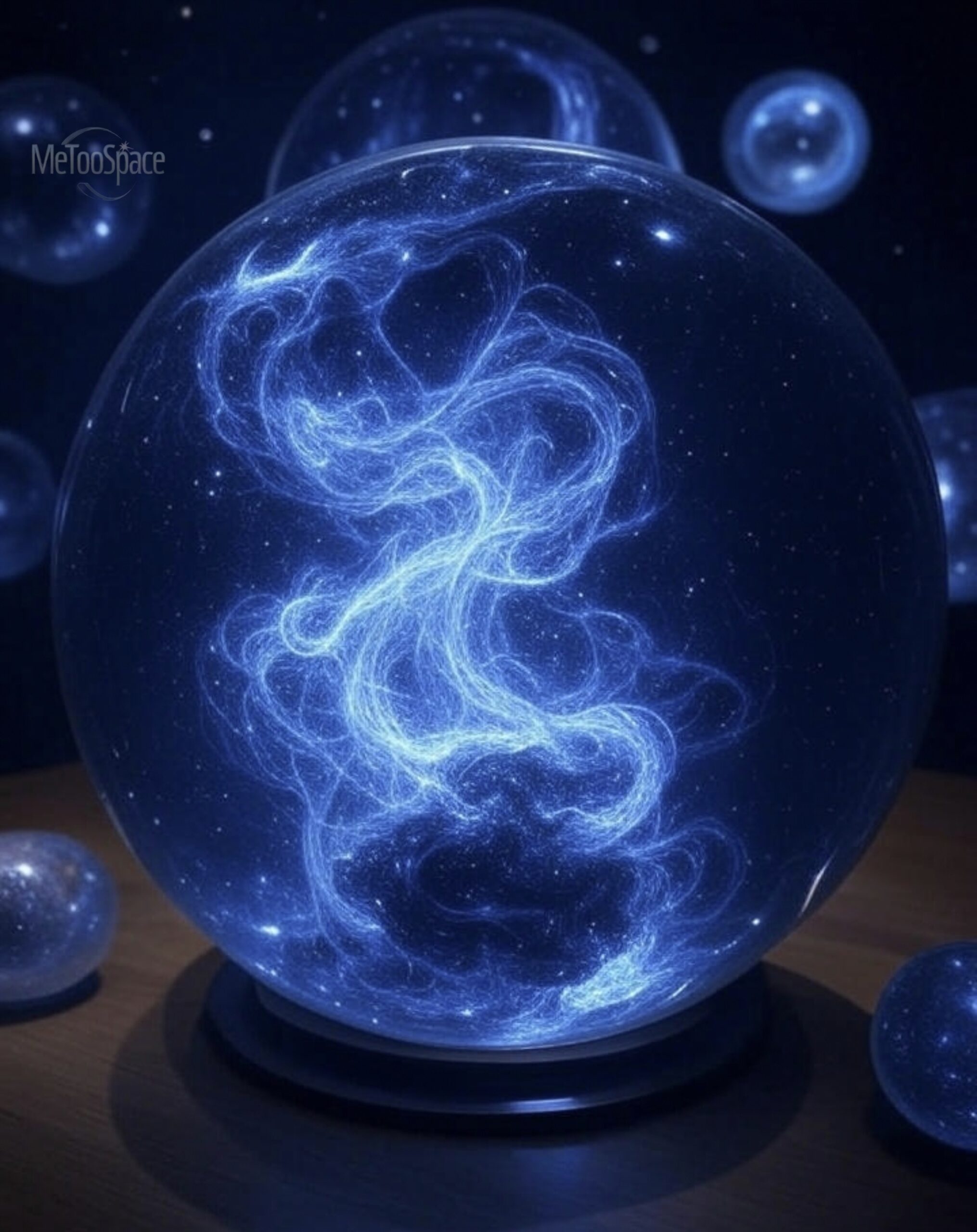
Understanding the Invisible Universe
When we observe the universe—stars, galaxies, planets—it might seem like we’re seeing everything there is. But what’s visible makes up just a small part of the cosmos. In fact, about 95% of the universe is made of things we cannot see directly: dark matter and dark energy.

What Is Dark Matter?
Dark matter is an invisible substance that doesn’t emit light or energy, but we know it exists because of its gravitational effects.
Galaxies rotate at such high speeds that they should break apart if only visible matter was present.
Instead, something unseen is providing the extra gravity needed to hold them together.
Though dark matter has never been directly detected, it helps explain:
How galaxies form and stay together?
Why light from distant objects bends as it travels through space (gravitational lensing)?
Dark Matter Facts:
Makes up about 27% of the universe
Doesn’t emit, absorb, or reflect light
Likely made of unknown particles
What Is Dark Energy?
Dark energy is even more mysterious. It is the force causing the universe to expand at an accelerating rate.
In the 1990s, scientists found that the universe’s expansion is speeding up.
This was unexpected—gravity should slow expansion down over time.
To explain this, scientists proposed a new form of energy—dark energy—that works against gravity.
Dark Energy Facts:
Makes up about 68% of the universe
Acts like a repelling force on large scales
Exact nature is still unknown
Why It Matters
Understanding dark matter and dark energy is one of the biggest challenges in physics and cosmology. These two components:
Influence the structure and fate of the universe
Could reveal new laws of nature
Are essential to understanding how galaxies evolve
The Search Continues
Researchers are:
Searching for dark matter particles in underground labs
Observing distant galaxies with advanced telescopes
Analyzing cosmic background radiation for clues about dark energy
Projects like the Euclid Space Telescope, James Webb, and Large Hadron Collider are all part of this effort.
In Summary
Dark matter holds the universe together.
Dark energy drives its expansion.
Together, they make up 95% of everything—yet we still barely understand them.
The universe is full of mysteries. And sometimes, the most important parts are the ones we can’t see.